

NBN vs FIBRE OPTIC – Australia’s Top Speed Internet Face-Off
Published April 21, 2026
Confused between NBN vs Fibre Optic Australia when making your internet connection decision? Well, rest assured, you aren’t alone here. And your choice might just be one of the deciding factors that will determine just how smoothly everything goes.
Given there are various types of NBN connections and so much talk about Fibre Speeds, it isn’t surprising if you are feeling confused and anxious about which one to choose. This is where the blog comes into play, providing an expert, lucid explanation of the situation.
The Way Every Internet Connection Works
Every internet connection isn’t the same. There are several types of infrastructure that affect how reliable, fast and efficient the connection is going to be. Check out the workings of Fibre Optic and NBN connections.
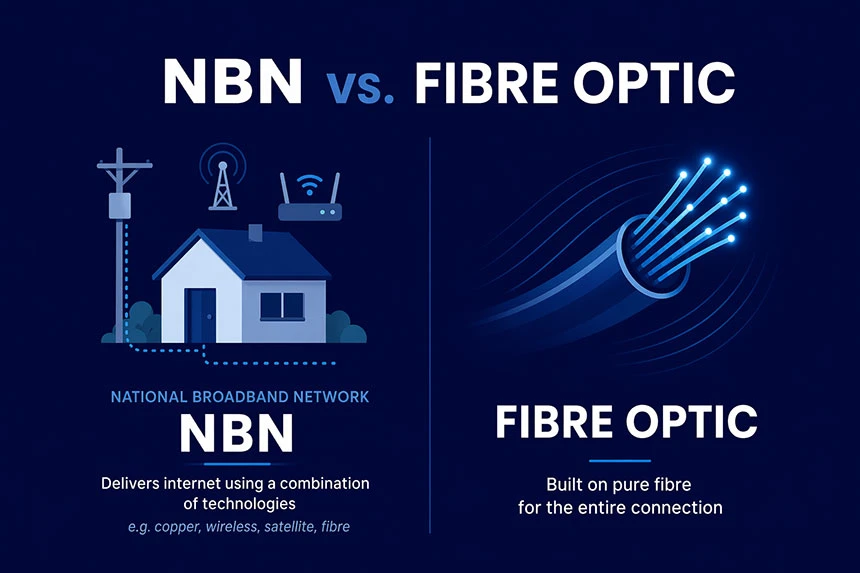
- Fibre Optic consists of an entire network of fibre cables to your premises called FTTP (Fibre to the Premises). In this system, data travels via light pulses.
- The term “National Broadband Network (NBN)” describes the government-sponsored broadband network in Australia that connects homes using a range of technology including copper, fibre-optic, fixed wireless, hybrid cable, and satellite.
Why is the Fibre Connection Faster?
The transmission of signals in a fibre connection is through optical fibre cables that should not be confused with electrical copper wires. Consequently, this method results in very little loss of signals, faster speed, and reliability regardless of distance. Compared to other NBN connections, fibre connections offer great resilience to disruptions or performance drops.
Transition: It should be noted that not all NBN connections are created alike. Here, we highlight some of the various kinds of NBN connections and how they fare compared to full-fibre connections.
Practical Advantages & Disadvantages
Every kind of connection has strengths and weaknesses. The table below highlights some of the advantages and disadvantages of each connection.
Advantages of the NBN Connection
Very widespread: Over 97% of households have access to NBN connections.
Diverse plans available: From basic to fast, it covers a wide range of budget needs.
Government backing: Upgrades continue to increase accessibility to FTTP connections.
Challenges of NBN
Different speed ratings: NBN network types with copper technology might not offer the intended speed.
Traffic: Much slower during the peak period in congested areas.
Speed Rating for Fastest Fibre: Ideal for gaming, streaming, and remote work
Reliability: Less likely to experience disruptions and have steady speed performance
Latency: Excellent for calling, online meetings, and gaming
The Final Words
In the ongoing dispute about NBN versus fibre optic, the choice is highly individualized when it comes to choosing what suits Australians best. While certain people might benefit from the widespread availability of NBN, others would prefer faster speed and reliability offered by fibre optics. Full fibre networks are bound to shape broadband across the entire Australia. With growing coverage by FTTP upgrades, more individuals will get the chance to enjoy fast-speed and reliable services.
With continued expansion of full fibre services, it makes sense to check whether your location allows switching. Your internet connection must meet all of your personal requirements in terms of work, leisure, and communication.
Stay informed with Utility Market for expert insights on NBN vs Fibre Optic Australia and follow us on Facebook for the latest updates and tips.