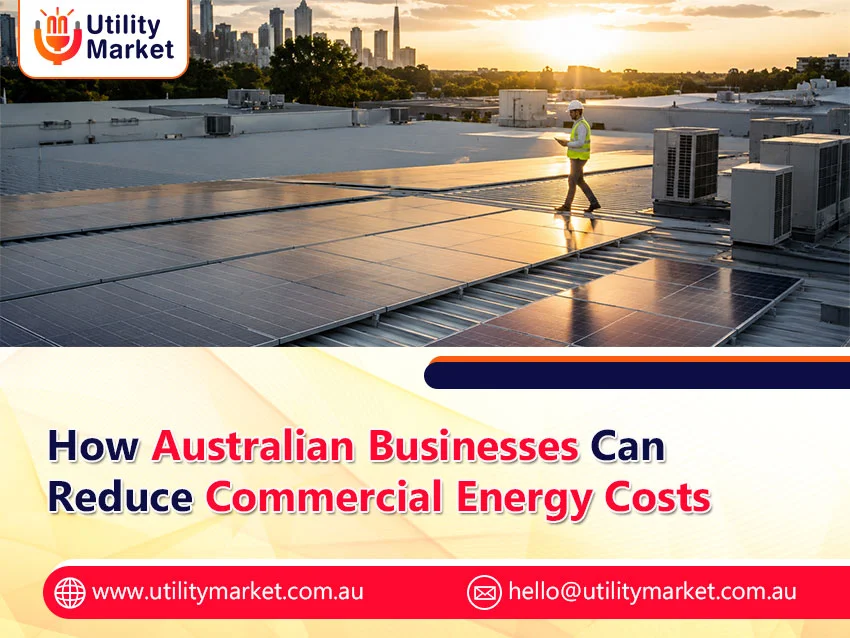
How Australian Businesses Can Reduce Commercial Energy Costs
Published June 22, 2026
Knowing how your company uses energy is the first step in lowering energy costs. Energy use for commercial purposes in Australia is economically significant as it takes up a large proportion of the country’s overall energy consumption from the national grid. Energy consumption is a chance to identify energy efficiencies for your bottom line.
Areas of Consumption
There are four main categories where the majority of energy is used in Australian commercial buildings. Identifying the one area that dominates your energy use will help you in choosing what upgrades to make.
HVAC (Heating, Ventilation, and Air Conditioning): This is often the highest energy user in an Australian building, especially in a commercial structure. Cooling a glass-fronted building in Brisbane during the summer or heating a warehouse in Melbourne during the winter takes huge quantities of energy. Small actions such as tweaking the temperature down by 1°C lowers energy use by HVAC systems by 10%.
Lighting: Old-fashioned warehouses and office buildings in Australia often have fluorescent bulbs or halogen high bay lights. These lighting fixtures are not very energy efficient. Replacing them with LED lights can cut lighting energy use by up to 50% to 80%.
Equipment and Process Loads: This includes servers for information technology, commercial refrigeration units, air compressors, and manufacturing equipment. In companies where data processing is intensive, server rooms need constant cooling, making energy consumption even more critical.
How to Create an Efficiency Roadmap
You can only manage what you can measure. Here is a data-driven path to reduced consumption:
Phase 1: Setting a Benchmark
Calculate your Energy Intensity. Your intensity equals your total annual kWh divided by your building’s square meterage. It helps to benchmark against similar facilities to understand how you’re doing. Your intensity should be considerably lower than that of your peers if you have any energy leaks.
Phase 2: Interval Data
With new smart meters, you can see how your consumption looks in 30-minute intervals. This data can be very revealing. It will show you whether you have any vampire loads – energy used during the night when the business is closed. If your consumption graph is not nearly zero by 2:00 AM, something is wrong.
Phase 3: The Efficiency First Rule
A major blunder that many people make is the installation of commercial solar power systems without addressing inefficiencies. You can easily reduce the cost of a solar power system by optimizing lighting and HVAC systems first because your consumption will be lower.
Renewable Energy Transition in Australia
There have been some fast transitions in the Australian energy market. At the moment, around 30% of energy comes from renewable resources such as solar, wind, and hydro, while the government wants 82% of all energy to come from renewable sources by 2030.
In terms of business opportunities, there are two:
On-site Power Generation: With solar panels, you can produce your own power on-site during those times of maximum energy consumption.
Sustainability: Lowering your energy consumption and using renewable energy sources is critical in B2B transactions.
Natural Gas for Businesses
Although there is an increasing trend of electrification, many companies in Australia continue to use natural gas for high-temperature processes like industrial ovens and boilers. With changes in gas prices, more businesses look at hybrid solutions where electricity-driven heat pumps are used to provide water and air heating and gas is kept for critical high-temperature processes.
Prepare Your Business for the Future
Energy prices are not going back to what they were ten years ago. Future proofing requires transitioning to a Smart Building. This entails the use of sensors to switch off the lights in unoccupied rooms and of HVAC systems with automatic settings depending on how many people are in a building.
Taking the actions that have measurable and visible results helps owners to shield their business from energy price volatility while contributing to the greener future.
Cut Your Energy Cost
At Utility Market, we will analyse your current bills, perform a fast assessment of your meter readings, and show you a concise list of actions that will decrease energy consumption in your business this quarter. Utility Market helps businesses optimize Commercial Energy Consumption Australia strategies through energy assessments, cost-saving recommendations, and smarter energy management solutions.