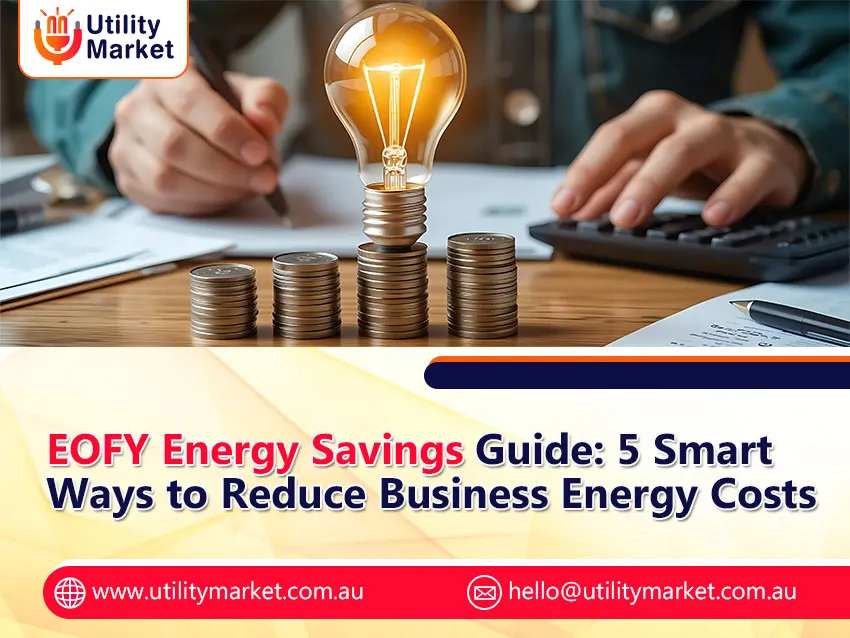
EOFY Energy Savings Guide: 5 Smart Ways to Reduce Business Energy Costs
Published October 30, 2026
We are fast approaching the end of another financial year. This is an ideal period during which business owners across the country are seeking opportunities to optimise their tax refunds and reduce their taxable incomes. However, this is also an ideal time to explore EOFY Energy Savings by assessing their energy expenses.
The increasing cost of energy has become one of the major concerns for Australian business owners. However, this does not mean that they simply need to accept it as a fact. The reality is that there are countless quick wins available to you, once you know where to look.
We will use this checklist to guide you on where to cut costs, organise your accounts and start FY26 as strong as possible. Let’s get down to it.
1. Review Your Energy Contract
One of the easiest things you can do to cut down on your energy expenditure is review your contract. It might seem obvious, but surprisingly it’s often the thing people neglect the most.
For instance, if your contract is about to expire (or has expired already), chances are you might find yourself locked in a default tariff that charges you a higher rate than you should. This kind of thing happens frequently within the energy industry, which means you’ll always be paying more than necessary since no one mentioned anything to you.
However, don’t worry, you’re not on your own in doing this. Utility Market can help you! You just have to schedule an energy assessment for free and get an idea of how your energy rate compares to others on the market.
2. Write Off Solar System at End of Financial Year
Perhaps you feel that solar power is an idea that should only be discussed during summertime. However, we believe that this period just prior to tax time is far better.
This is because EOFY means that it is almost too late to make use of some tax incentives that can save you money such as the instant asset write off on eligible commercial solar power systems.
If you don’t know what this program is, let us give you some insight: This program enables you to get an immediate deduction of your expenditure on eligible assets such as solar power. In essence, you will claim a big chunk, if not the total, cost of your newly acquired solar power system within this particular financial year.
3. Review Your Network Tariff
The network tariff is the price charged for using the network to distribute energy. It depends on various aspects, such as location, connection and patterns of consumption, and it is not the same as the energy tariff and is not set by your retailer.
What is more, many small and medium-sized enterprises use old-fashioned tariffs that do not represent their consumption anymore.
4. Verify Your Energy Charges
Are you sure that your energy charges are correct? You will be surprised to learn just how often energy bill overcharging occurs.
Mistakes and errors in energy billing are much more widespread than companies tend to know about. Right from incorrect metering to mismatched tariffs, any little error can make a big difference in the end. But if you are not verifying your billing, you may not even realize what’s happening with your profits.
As the end of the financial year approaches, it is important for you to ensure that your books are in order, precise and contain no unpleasant surprises. Such an audit will allow you to find additional money or clarify your future energy expenses for FY25.
5. Book an Energy Health Check
While EOFY is an ideal time to assess the year that just past, it’s also an opportunity to set yourself up for success for the year to come.
One of the most strategic steps to ensure you are well-placed for any future changes in energy costs is by way of an energy health check, which allows you to get a full picture of where you stand right now, from energy usage to overspend and potential savings in solar and other areas.
No matter what your objectives are in the upcoming financial year, there’s not one objective that can’t be met while reducing your energy spend. Here at Utility Market, we make it incredibly easy. Simply book your free energy assessment today.
Frequently Asked Questions About EOFY Energy Savings
Some of the best EOFY energy savings strategies include reviewing your electricity contracts, checking network tariffs, verifying energy bills, considering commercial solar installations and arranging an energy health check. These steps can help businesses identify unnecessary expenses and find opportunities to reduce energy costs in the new financial year.
Yes, eligible businesses may be able to claim tax deductions for commercial solar systems under applicable tax incentive schemes, including the instant asset write-off where eligibility requirements are met. The deduction depends on the business's circumstances, asset cost and relevant financial-year rules. Businesses should check the latest Australian Taxation Office (ATO) guidelines or consult a tax professional before making a purchase.
Reviewing an energy contract helps businesses identify whether they are paying competitive electricity rates. Businesses approaching the end of their existing contracts should compare available offers and check for higher default rates, unnecessary charges and unfavourable contract conditions. Switching to a more suitable energy plan can potentially reduce ongoing electricity expenses.
A network tariff is the charge associated with transporting electricity through the electricity distribution network. It can depend on factors such as location, connection type and electricity consumption patterns. Reviewing network tariffs helps businesses determine whether their current tariff structure still suits their operations and usage patterns.
An energy health check provides businesses with a clearer understanding of their electricity usage, billing accuracy, contract rates and potential savings opportunities. It can identify unnecessary expenses, inefficient consumption patterns and opportunities for solar installations or better energy plans. Regular assessments can help businesses manage energy costs more effectively throughout the financial year.
Make the most of EOFY Energy Savings with Utility Market and discover smarter ways to reduce your business energy costs.