
The Economics of Renewable Energy: Costs, Challenges and the Road to a Sustainable Future
Published October 1, 2026
Australia’s electricity sector is now moving towards a time of great change, which could have an impact on business electricity costs Australia. In the coming years, a number of coal power plants will be closed, while electricity demand for data centres is forecast to increase sharply and prices are rising for electricity futures over the next decade. From a business perspective in Australia, an understanding of these trends can be useful for the process of negotiating electricity contracts in the future.
Closing of Coal Power Plants Is Changing Electricity Generation in Australia
Despite being still significant in the NEM, coal generation is gradually being retired due to aging facilities and the transition to clean energy sources. According to the currently available information, almost 11 GW of coal generation capacity will be retired by 2033.
The largest share of retirement is expected between 2028 and 2029, and again in 2033. New capacity must be built up to replace retiring generation in order to satisfy electricity demand in the future.
Prices in the Electricity Futures Market Will Be Higher as the Decade Progresses
The electricity futures market in Australia is yet another source that tells us how the market is currently pricing electricity for the years to come.
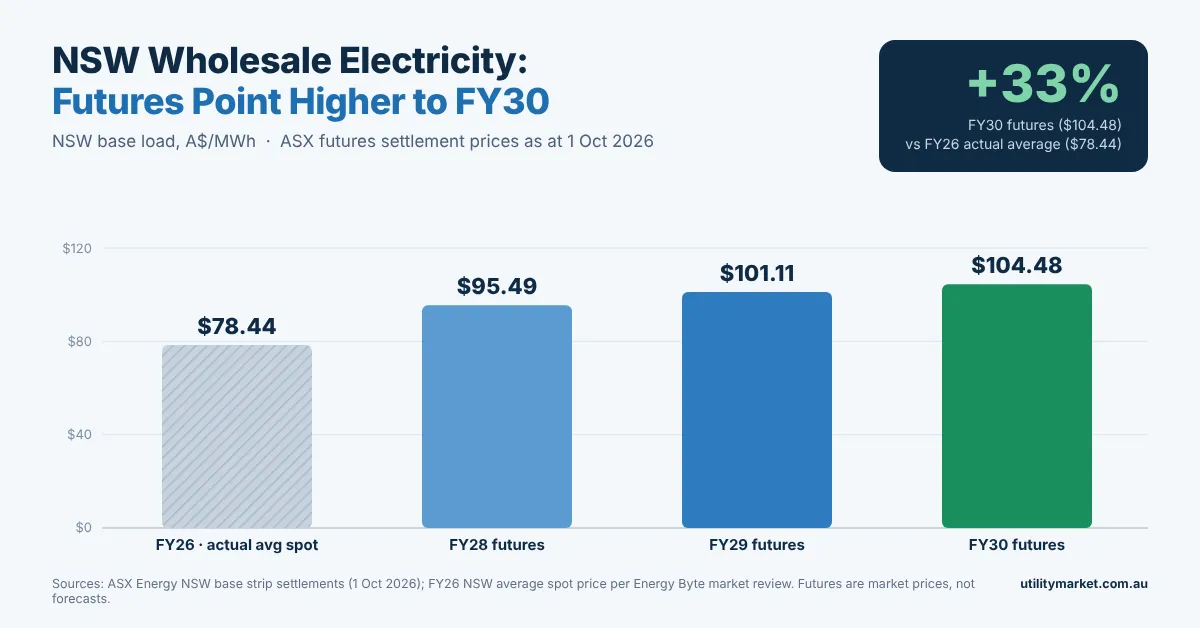
According to NSW base futures on the ASX, wholesale electricity for FY30 is currently priced at around $104/MWh. That is roughly 33% higher than the actual average NSW wholesale price of about $78/MWh in FY26.
Futures prices are not a forecast of electricity prices in these years, but rather reflect how the electricity is currently priced for the future periods in the wholesale market, and can fluctuate accordingly.
The Implications of Australia’s Evolving Electricity Market for Business Energy Costs
From a business perspective, what matters is that a lot of change is underway on both the generation side and the demand side of the electricity market. Generation will be evolving with the closure of coal-fired power plants, and the expectation is that electricity demand will rise with the advent of new electricity consumers such as data centres.
Meanwhile, the forward market shows that wholesale electricity costs are rising further ahead into the decade. If your business is going to be renewing its electricity contracts in the coming months or years, it may be worth looking at your future electricity position early rather than waiting until your current contract comes up for renewal.
The Case for Early Review of Electricity Contract
Prices of business electricity fluctuate rapidly depending on factors such as expectations of electricity supply, demand, availability of generation capacity, weather, and other factors from the energy market.
It is not assured that current electricity prices represent the best prices that can be obtained in the market.
What businesses can do is base their decisions on current market information.
Given planned power stations closures, significant rise in demand for data center electricity and high futures pricing towards the next decade, an early review of electricity contract will help you gain insight about your options before things change in the market.
Check Out Your Business Electricity Agreement
When it comes to renew your business electricity agreement or when you need to check out what pricing is available, it might be a good time to look at your energy agreement. Utility Market can evaluate your existing contract for electricity, its expiry, as well as your energy use to help you find better deals from other electricity providers.
For more insights on business electricity costs Australia, turn to Utility Market for practical energy market information.
Follow Utility Market on Facebook for the latest updates on energy prices, contracts and market trends.