

Why Regular Network Tariff Reviews Matter for Your Bottom Line
Published June 17, 2026
Each year, every commercial and industrial power bill in Australia changes on one specific date – 1 July. On every 1 July, all network tariffs are revised in Australia. While most companies do not see the difference on their invoice until weeks later, however the fact is – 24% of all reviewed sites have the potential to move onto a better tariff.
Distribution Networks publish new tariffs each year under the AER-authorized pricing framework. Naturally a steep rise or fall can be expected. There are times when entire tariff structures have been revised, with networks moving towards more cost-reflective pricing where possible. To most companies, the changes will show up on their invoice a few weeks later as some sort of mystery charge. The review period would be too late, again, for another year.
What network tariffs are and why they require a dedicated review
When an industrial customer looks at their energy bill, every single component of cost stands out in its own distinct line on the bill. The retail energy price will have been negotiated with the retailer, while network tariffs, environmental scheme costs and metering costs are separately itemized. This means that a company can renegotiate their energy rate contract and yet receive a different bill overall, because the other items are outside the control of the retailer.
Many companies do not realize that their network tariff structure can be re-examined and changed as needed. A network tariff review asks the following: given the consumption behavior, location within the network area and classification of a particular property, is the company paying the correct network tariff for itself? Does anything need to change based on the company’s development?
Companies grow. They change their load profile. Solar power comes into play. The production process shifts. While an optimal tariff arrangement three years ago would have worked well, a company might find itself stuck with a tariff arrangement that no longer suits them.
Insight from the data
From NTRs conducted at commercial and industrial clients in Australia, 62% of these sites have the correct tariff at the moment. However, in 24% of these situations, there is an alternative choice that works better.
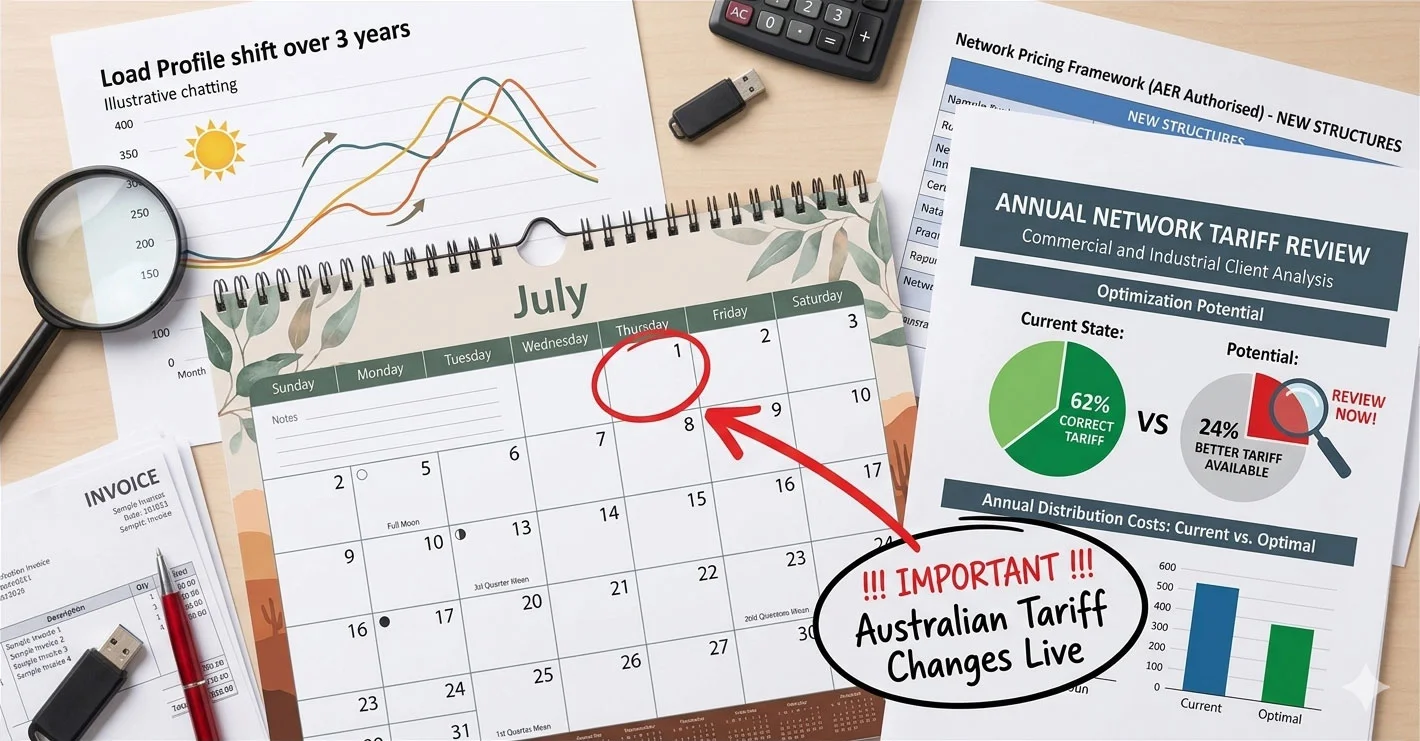
For commercial energy procurement customers, some companies conduct Network Tariff Review (NTR), which forms part of the annual energy management cycle. The team analyzes interval data of the particular site against the different tariff structure of the network. They determine whether the site requires making a tariff classification change to the network.
In either situation, where staying on the current tariff structure works best, we recommend so. On the other hand, when a change is required, we make the recommendation, conduct the change process and work alongside with the network company to successfully complete the process. At all cost, the client has to enter the new year tariff with a resolution.
Network fees will keep changing. Those businesses that effectively manage their network fees are those that schedule the review. Regular tariff assessments help businesses stay aligned with changing energy costs and avoid unnecessary network charges. Utility Market’s Network Tariff Review Australia service helps identify opportunities to optimise electricity spend and improve long-term savings.
Follow us on Instagram for energy insights, market updates and practical cost-saving strategies.