A Renter’s Guide to Comparing Electricity Plans in Victoria
Published September 2, 2026
If you rent, chances are you’ve moved at least once in the last couple of years. Every move means starting from scratch with a new electricity account, a new address and usually a bill that turns up higher than you expected. Renters get a slightly different version of the “should I switch providers” problem than homeowners do. You can’t add solar panels to a place you don’t own. You might be gone again in twelve months. And a lot of the standard advice out there assumes you’re settled somewhere long-term, which most renters simply aren’t.
Here’s what actually matters when you’re renting and trying to compare electricity plans in Victoria, Australia, without wasting time on advice that doesn’t apply to you.
Victoria’s Benchmark Price Isn’t What You Think It Is
Victoria runs its own regulated benchmark called the Victorian Default Offer, or VDO, reset each year by the Essential Services Commission. A lot of people assume it’s the cheap option. It’s actually the opposite. It’s a price ceiling, the maximum a retailer can charge you on a standing offer. Most competitive plans sit below it once discounts are applied, so if you’re comparing your current rate against the VDO and thinking you’re doing fine, you might just be comparing against the wrong number.
What Renters Should Actually Pay Attention To
Skip past the parts of a bill that assume you own the place. You’ll still see the same basic structure. There’s a daily supply charge just for being connected and a usage rate per kilowatt-hour, sometimes split into peak, off-peak and shoulder pricing depending on your meter. Solar feed-in tariffs, on the other hand, usually aren’t relevant unless your landlord has already installed panels and you’re benefiting from them, so don’t waste time comparing feed-in rates if there’s nothing on the roof.
What matters more as a renter is contract length and exit fees. A 24-month plan with a great rate isn’t much use if you’re likely to move again before it ends and get stung with an early exit fee on the way out. It’s also worth finding out which local network provider services the property, since that affects part of your charges no matter which retailer you sign with and it changes every time you move somewhere new. You’ll usually find this listed on a recent bill for the address, or you can ask when getting a quote.
How to Compare Plans When You Might Move Again Soon
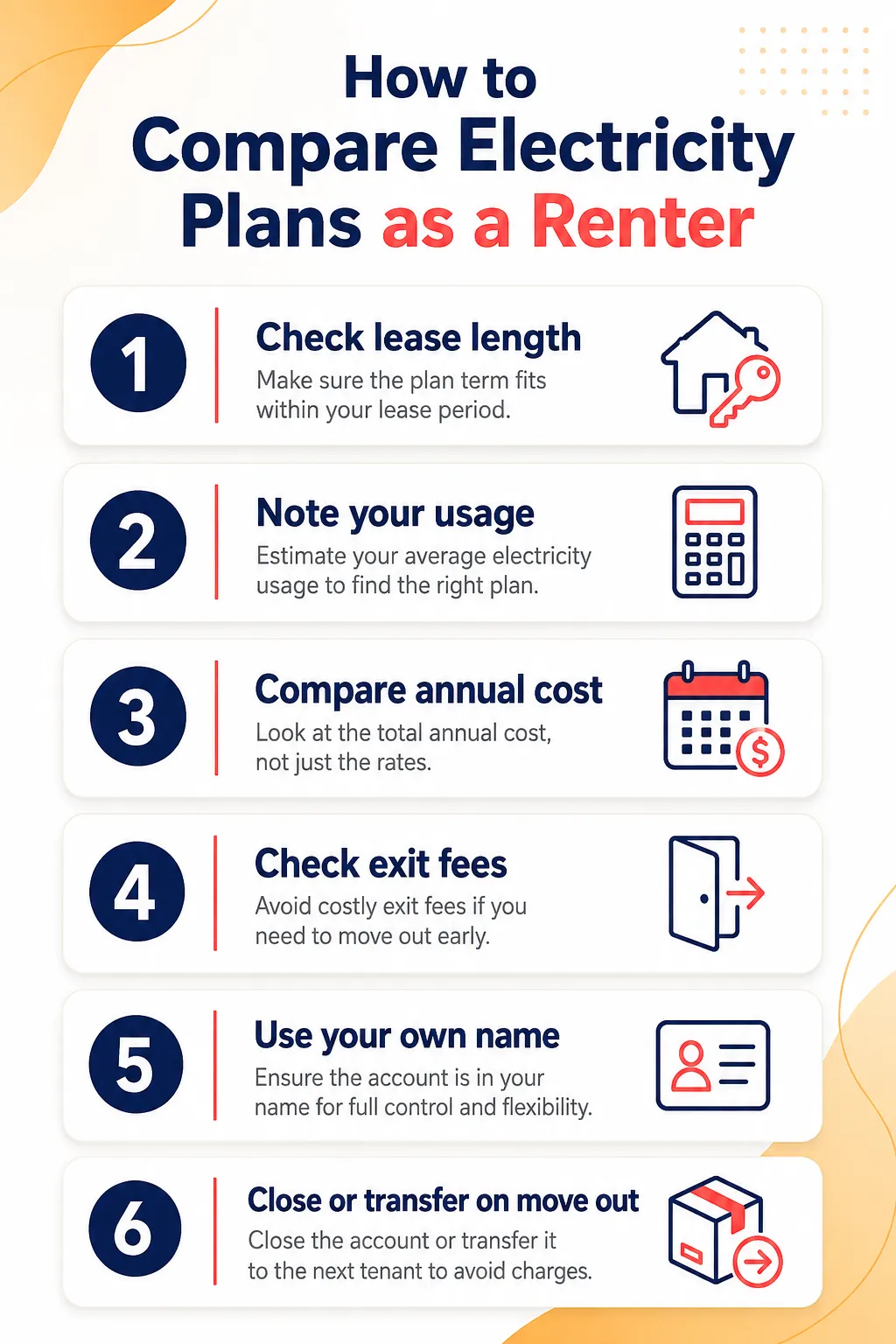
- Check your lease length before locking into anything. If you’re on a 6- or 12-month lease, a no-lock-in or short-term plan is usually smarter than a long fixed-term contract with exit fees.
- Pull up your current bill and note your usage in kWh. Even a partial bill from the new address gives you a baseline to compare against.
- Compare estimated annual cost, not the advertised rate. A low headline rate with a high supply charge can cost more overall, especially if you’re in a smaller share of a house or apartment with lower usage.
- Ask what happens if you leave early. Plans without exit fees are worth a slightly higher rate if there’s a real chance you’ll be moving again.
- Set the account up in your own name from day one. It’s tempting to just keep paying whatever the previous tenant had running, but that usually means an outdated plan, not necessarily a good one.
- When you move out, actively close or transfer the account rather than assuming it happens automatically. Final bills and connection dates can get messy otherwise.
Inner Melbourne vs Outer Suburbs and Regional Areas
If you want to compare electricity plans in Melbourne specifically rather than Victoria as a whole, location matters more than most renters realise, since renters tend to move around a lot more than owners do. Inner and middle Melbourne is generally serviced by different local network providers than the outer suburbs and regional Victoria and network charges in regional areas tend to run a bit higher, mostly because maintaining infrastructure over greater distances simply costs more. So the “best deal” you found for your last share house in inner Melbourne might not be the best deal at your next place if you’re moving further out. It’s worth re-comparing every time your address changes, not just assuming your old plan comes with you.
Common Mistakes Renters Make With Electricity
Signing a long, fixed-term contract without checking the lease length first is the big one. It’s easy to lock in a great rate and then pay an exit fee six months later when the lease ends. Inheriting the previous tenant’s plan is another common trap. It might be fine, but it’s rarely the best available deal and you won’t know unless you actually check. Skipping the connection transfer when moving out is a smaller but annoying mistake, since it can leave you liable for usage after you’ve left, or leave the new tenant without power on move-in day. And plenty of renters simply never re-compare after their first year, even though a decent chunk of the “great deal” they signed up for was a first-year discount that’s since rolled off.
Renter FAQs
No. Switching retailers is your choice as the account holder. Your landlord isn't involved in that decision, only in things like adding fixed infrastructure such as solar panels.
If your lease is short or you're not sure how long you'll stay, a no-lock-in plan is usually the safer choice, even if the rate is marginally higher, since it avoids exit fees if you move.
You'll need to arrange a disconnection or transfer date with your retailer, usually a few days before your lease ends, so the account closes properly and the next occupant can connect under their own name.
Yes. Network charges depend on the address, not on you personally, so a plan that made sense at your last place isn't automatically the best option at the new one.
Bottom Line
Renting adds a few extra variables to the “which electricity plan” question: lease length, exit fees and the fact that you might be doing this all again in a year. The short version is this. Check that the VDO isn’t lulling you into a false sense of a good deal, favour flexibility over long lock-ins if your lease is short and get in the habit of comparing again every time you move rather than just inheriting whatever plan was already running at the address.
Whether you’re doing a broad electricity comparison across Australia or narrowing it down to compare electricity plans in Australia’s more competitive states like Victoria, the habit is the same. Check again before you settle for a plan, especially as a renter who’s likely to move again before too long.