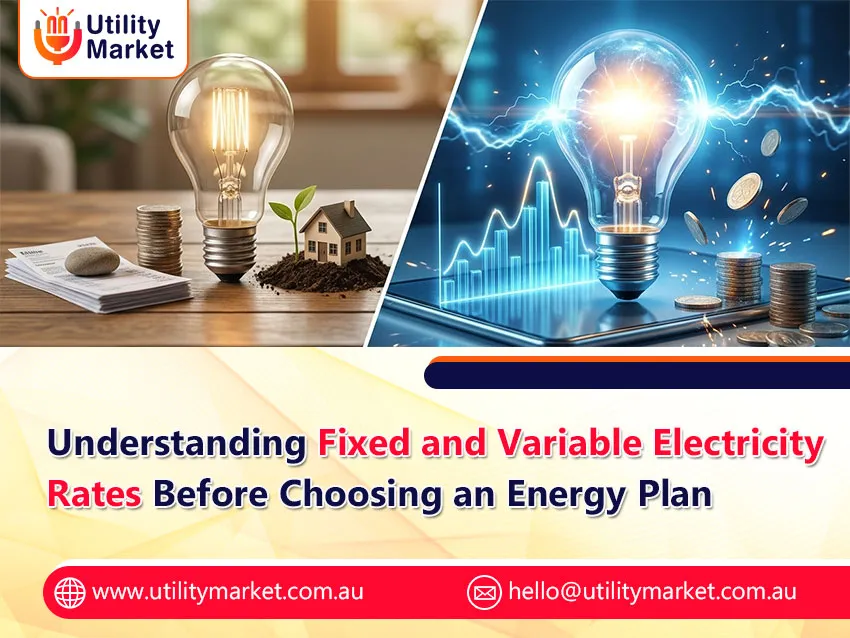
Understanding Fixed and Variable Electricity Rates Before Choosing an Energy Plan
Published November 17, 2026
A fixed price electricity plan ties you to set prices for your power for a certain period of time. As a result, your retailer cannot change the prices during that period of time. Under a variable price electricity plan, your retailer may increase your rates at his discretion.
Previously, retailers under a variable plan could raise prices several times a year. As of 1 July 2026, national regulations will apply a 12-month restriction on price increases to all market plans. This guide describes what fixed and variable plans imply now, what a fixed price actually protects from and how to determine which plan to choose for yourself and your household.
What is a fixed price electricity plan?
Fixed price electricity plan is a market plan under which your retailer agrees not to increase your rates during the period following your enrolment. During that period your usage rate (cents per kWh) and your daily supply charge remain unchanged.
Fixed price periods are commonly 12 months but may differ from the contract term. For instance, the contract term may be two years, but prices may be fixed only in the first year of a plan.
Additionally, some fixed price plans guarantee that your feed-in tariff will also be fixed. Check your contract documentation to find out whether your plan includes the guarantee of fixing your feed-in tariff, as it is different from one retailer to another.
What is a variable rate electricity plan?
Variable rate plans refer to market plans in which the retailer has the right to change your electricity rates at any time within the contract period. The majority of the market plans are variable plans. Even in the case of variable plans, changes will happen only when a retailer changes your rates. Variable rate plans are usually ongoing plans without any expiry date. As a result, you have the right to switch the plan anytime if you are using the ongoing market retail contract.
Fixed vs Variable Electricity Rates: Key Differences
| Feature | Fixed Price Plan | Variable Rate Plan |
|---|---|---|
| Electricity usage rate | Remains unchanged during the fixed price period | Can change subject to applicable rules |
| Daily supply charge | Remains unchanged during the fixed price period | Can change subject to applicable rules |
| Price certainty | Greater price certainty | Less price certainty |
| Price increases | Generally after the fixed price period ends | Subject to the 12-month price increase restriction |
| Price decreases | Depends on the plan terms | Retailer may pass on price reductions |
| Contract duration | May have a fixed contract term | Often available as an ongoing plan |
| Flexibility | May involve exit fees or conditions | Usually easier to switch |
Note: Actual plan conditions vary by retailer. Check the plan information sheet and contract terms before signing up.
Impact of the change on fixed and variable plans effective July 2026
The Australian Energy Market Commission (AEMC) introduced the rule to cap price rises in market retail contracts, effective 1 July 2026. The rule applies to new and existing contracts in jurisdictions subject to the National Energy Retail Rules- NSW, Queensland, South Australia, ACT and Tasmania.
As per AEMC’s final determination,The retailers would be allowed to raise prices once a year, within 12 months’ period, depending upon the nature of the plan.
An increase may take place in the month of July for a variable plan annually for the majority of customers.
For a fixed-price period plan, the increase may take place from the date of the anniversary of the contract and not less than 12 months since the last increase. Impact of the change on fixed and variable plans effective July 2026.
Which type of plan suits your household?
A fixed price plan is worth considering if you want certainty about your rates for the next 12 months or more, you expect to stay at your current address for the full fixed price period and you’d rather not deal with a July price change soon after signing up.
A variable rate plan is usually the better fit if you’re likely to move house, you want the option to switch whenever a better offer appears, or you’d like price decreases passed on as soon as your retailer makes them.
How to determine whether a plan price is fixed before signing
Each retailer is required to have a plan information sheet for each plan, which displays the price, fees, contract term and discounts and their terms. To know whether the plan is fixed or not, check the following.
- Determine the fixed price period and not contract period. The fixed price period is usually provided in the document. In case there is no mention of the fixed price period, the price is assumed to be variable.
- Compare the fixed price period and contract period. In case there is a 12 months’ fixed price period on a 24 months’ contract period, you will be subject to price increase during the second year despite having signed a contract.
- Check what’s included. Determine whether the daily supply charge, usage rates and solar feed-in tariff are fixed or not.
- Determine the exit fee and its reduction period.
- Determine the important dates. Record the end date of the fixed price period and also the benefit period’s end date.
Frequently Asked Questions About Fixed and Variable Electricity Rates
Not necessarily. Fixed rates offer price certainty, but variable plans may sometimes offer lower prices. Compare the usage rates and daily supply charges before choosing.
No. From 1 July 2026, the new 12-month restriction applies to electricity market retail contracts in jurisdictions covered by the National Energy Retail Rules.
Generally, yes. However, some retailers may charge an exit fee or impose other conditions. Check your contract before switching.
No. It generally protects the agreed rates during the fixed price period, but your total bill can still change depending on electricity consumption.
Your retailer may move you to another plan or apply different rates according to the contract terms. Check the notification from your retailer before the fixed price period ends.
Yes. Retailers may reduce variable rates, although the timing and extent of reductions depend on their pricing decisions and applicable rules.
Compare fixed and variable electricity rates with Utility Market to find an energy plan that suits your household and budget.
Follow Utility Market on LinkedIn for the latest Australian energy news, insights and electricity market updates.